
WCAG 2.2 Compliance for Ecommerce Websites: Why Waiting for a Fine Is the Costliest Strategy
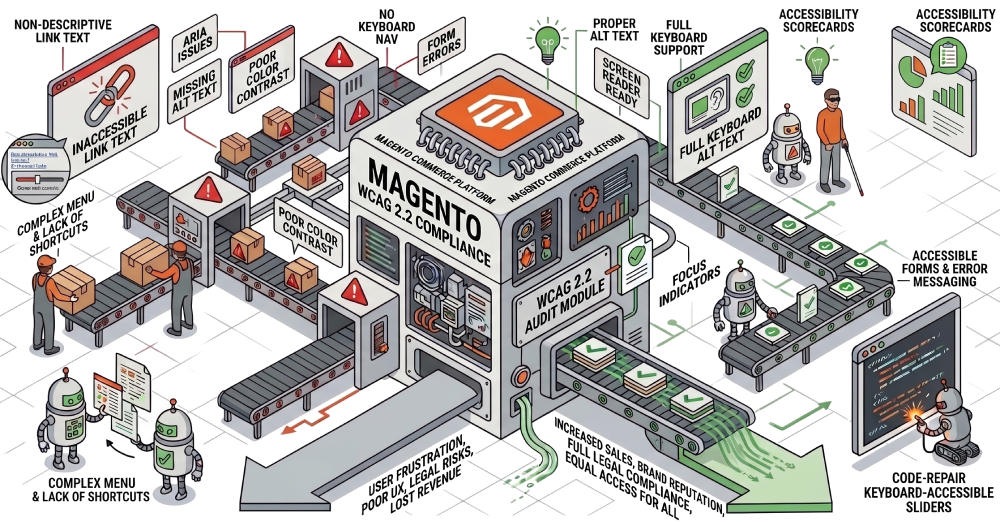
Most ecommerce businesses discover their accessibility obligations the hard way. A demand letter arrives. A regulator makes contact. A lawsuit is filed. Only then does WCAG 2.2 compliance become urgent.
This is the reactive model, and it is significantly more expensive than the alternative. The fine is the beginning, not the end. Legal costs, remediation under pressure, reputational damage, and the cost of rebuilding in a hurry compound on top of the penalty itself.
There is a second problem that rarely gets discussed alongside the fine: most agencies do not have the expertise to deliver accessibility compliance themselves. The typical response is to outsource the work to a specialist. That introduces a third party who does not know your platform, your integrations, or your codebase. Fixes are applied in isolation. Things break. Ownership falls through the gap between partners.
This article explains what WCAG 2.2 compliance requires, where it is legally mandated, what the financial exposure looks like across the geographies most relevant to ecommerce brands, and why the only reliable path to compliance is a single technical partner who owns the full picture.
Accessibility compliance is not a nice-to-have. In an increasing number of jurisdictions it is a legal requirement with enforceable financial penalties. The brands that treat it proactively, with one team who understands the whole platform, spend a fraction of what the reactive ones pay.
What WCAG 2.2 Is and Why It Matters
The Web Content Accessibility Guidelines (WCAG) are published by the World Wide Web Consortium (W3C) and define the international standard for digital accessibility. WCAG 2.2, published in October 2023, is the current version. It builds on WCAG 2.1 with nine new or updated success criteria focused on users with cognitive disabilities, motor impairments, and low vision.
WCAG is organised into three conformance levels:
- Level A (minimum): The baseline. Failure at this level means significant groups of users cannot access your site at all.
- Level AA (standard): The level required by most legislation globally. This is the target for every ecommerce brand with legal exposure.
- Level AAA (enhanced): Best practice. Required in some public sector contexts, less commonly mandated for commercial sites.
When regulators, courts, and accessibility legislation reference WCAG, they almost always mean Level AA. WCAG 2.2 Level AA is what your compliance programme needs to target.
The Legal Framework: Where Accessibility Compliance Is Mandated
Accessibility legislation is not limited to a single geography. For ecommerce brands operating across multiple markets, the combined legal exposure is significant.
United States: Americans with Disabilities Act (ADA)
The ADA (42 U.S.C. § 12101) prohibits discrimination against disabled individuals in public accommodations. Courts have consistently held that commercial websites constitute places of public accommodation under Title III of the Act, creating legal obligations for website accessibility.
In April 2024, the Department of Justice (DOJ) issued a final rule under Title II requiring state and local government entities to meet WCAG 2.1 Level AA. For private sector ecommerce brands, legal exposure comes via civil litigation rather than a specific federal rule, but the trajectory is clear: thousands of ADA web accessibility lawsuits are filed annually, and the numbers have grown every year since 2017.
ADA civil penalties administered by the DOJ can reach $75,000 for a first violation and $150,000 for each subsequent violation. Private plaintiffs can seek injunctive relief and attorney’s fees. Class action settlements in ADA web accessibility cases have reached into the millions.
European Union: European Accessibility Act (EAA)
The European Accessibility Act (Directive 2019/882) is the most significant regulatory development for ecommerce accessibility compliance globally. It came into full effect on 28 June 2025 and applies to private sector businesses selling to consumers in EU member states, including ecommerce websites and mobile apps.
The EAA requires websites and apps to meet the EN 301 549 standard, which incorporates WCAG 2.1 Level AA. Each EU member state is responsible for setting and enforcing its own penalty regime. Penalties are required by the Directive to be “effective, proportionate and dissuasive.” Businesses that are non-compliant and continue trading into EU markets after the deadline are in active violation.
Germany, France, the Netherlands, and other major EU ecommerce markets are all implementing enforcement frameworks. For brands generating revenue from EU customers, this is not a future obligation. It is a present one.
United Kingdom: Equality Act 2010
The Equality Act 2010 prohibits discrimination against disabled people in the provision of goods and services, including digital services. Section 20 of the Act imposes a duty on service providers to make reasonable adjustments to remove barriers that prevent disabled users from accessing services. Courts have interpreted this to include website accessibility.
The public sector is additionally subject to the Public Sector Bodies (Websites and Mobile Applications) Accessibility Regulations 2018 (PSBAR), which explicitly mandate WCAG 2.1 Level AA compliance. While PSBAR applies specifically to public bodies, the Equality Act provides a parallel route of legal exposure for private sector ecommerce brands.
Claims under the Equality Act can result in compensation awards with no statutory cap, plus legal costs. The reputational and operational costs of a public enforcement action typically exceed the direct financial penalty.
Canada: Accessibility for Ontarians with Disabilities Act (AODA)
The Accessibility for Ontarians with Disabilities Act (AODA) requires private sector organisations with 20 or more employees to meet WCAG 2.0 Level AA by specific deadlines. For large organisations (50 or more employees), compliance has been required since 2021. The maximum fine under AODA is $100,000 CAD per day for corporations. Federal legislation under the Accessible Canada Act (S.C. 2019, c. 10) extends obligations further for federally regulated organisations.
Australia: Disability Discrimination Act 1992 (DDA)
The Disability Discrimination Act 1992 prohibits discrimination against people with disabilities in the provision of goods, services, and facilities. The Australian Human Rights Commission has published guidance treating web accessibility as a DDA obligation. Complaints can result in conciliation processes and, if unresolved, Federal Court proceedings with compensation and injunctive relief.
Accessibility Legislation at a Glance
|
Geography |
Legislation |
Standard Required |
Financial Exposure |
|
USA |
ADA Title III |
WCAG 2.1 AA (de facto) |
Up to $75,000 first violation; $150,000+ subsequent; class action settlements in the millions |
|
EU |
European Accessibility Act (Dir. 2019/882) |
WCAG 2.1 AA via EN 301 549 |
Member-state penalties; effective, proportionate, and dissuasive by law; June 2025 enforcement active |
|
UK |
Equality Act 2010 / PSBAR 2018 |
WCAG 2.1 AA (public sector); reasonable adjustment (private) |
Uncapped compensation; legal costs; enforcement action |
|
Canada |
AODA / Accessible Canada Act |
WCAG 2.0 AA |
Up to $100,000 CAD per day for corporations |
|
Australia |
DDA 1992 |
WCAG 2.0 AA (guidance) |
Federal Court proceedings; compensation; injunctive relief |
The Real Cost of Reactive Compliance
The fine is the most visible cost. It is rarely the largest one.
When a brand is forced into compliance by a regulator or a lawsuit, the remediation process happens under time pressure, legal scrutiny, and without the advantage of planning. What might take a structured programme several weeks to address in an orderly way becomes an emergency engagement at emergency rates, with every decision made under deadline.
The full cost of reactive compliance typically includes:
- Legal defence costs: Solicitor or attorney fees to respond to a complaint, demand letter, or regulatory inquiry. These costs begin before any finding of liability.
- Emergency remediation: Development work completed under time pressure typically costs significantly more than planned remediation. Rushed fixes also introduce new risks.
- Regulatory settlement or penalty: The fine itself, which in most jurisdictions compounds with each day of continued non-compliance.
- Reputational damage: Public enforcement actions, negative press, and social media coverage affect brand trust in ways that are difficult to quantify and slow to recover from.
- Lost revenue during remediation: Development resources pulled into compliance work cannot be deployed on revenue-generating improvements.
The brands that treat accessibility compliance as a planned programme spend a fraction of what the reactive ones pay, and they do not hand their legal exposure to a solicitor first.
Why Most Agencies Cannot Deliver Accessibility Compliance
Accessibility compliance is technically demanding. It requires depth across frontend architecture, semantic HTML, ARIA implementation, keyboard interaction patterns, screen reader behaviour, colour science, and form engineering. Most development agencies do not hold this expertise in-house. The typical response when a client asks for WCAG compliance is to outsource the audit and remediation to an accessibility specialist.
This creates a structural problem that is almost identical to the one Foxycom addresses in platform ownership more broadly: the people diagnosing the problem are not the same people who built and maintain the platform, and the people making fixes do not have visibility into the systems those fixes sit inside.
When an external accessibility specialist audits a Magento or Adobe Commerce store, they produce a list of issues referenced against WCAG criteria. That list is accurate. But implementing the fixes is where the complexity lives, because accessibility on an ecommerce platform is not a standalone layer. It is woven through every component of the site.
The specialist sends the remediation list back to the agency. The agency’s developers, who were not involved in the audit and have no deep accessibility expertise, implement the fixes as tasks. Changes to the checkout form affect payment integrations. Changes to navigation components affect caching behaviour. Changes to interactive elements affect third-party extensions. Without a single team holding both the accessibility knowledge and the platform knowledge, fixes are applied in isolation and regressions go undetected.
When accessibility is outsourced, the audit happens in one place, the fixes happen in another, and accountability for the outcome belongs to nobody. The brand ends up with a report, a partially remediated site, and two sets of invoices.
Why Accessibility Compliance Cannot Be Treated in Isolation
WCAG 2.2 compliance is not a discrete workstream that can be lifted out and handed to a specialist. It is interrelated with almost every technical layer of an ecommerce website.
Consider the scope of what a proper compliance programme touches on a Magento or Adobe Commerce platform:
- Frontend theme and templates: Every page template, component, and layout needs to be assessed. Heading hierarchies, landmark regions, focus management, and semantic markup are embedded in the theme layer and affect every page on the site.
- Checkout and payment flows: The checkout journey is typically the highest-stakes area for accessibility failures. Error handling, field labelling, keyboard navigation through multi-step flows, and screen reader announcements all require hands-on engineering. Changes here interact directly with payment extension code and order processing logic.
- Search and filtering: Algolia, Klevu, and native Magento search all have accessibility considerations. Dynamic content updates must be announced correctly to assistive technologies. Filter interactions must be keyboard-operable. These are integration-level concerns, not surface-level fixes.
- Third-party extensions: Loyalty programmes, live chat, review widgets, and promotional popups are all part of the accessibility surface. Many introduce failures independently of the core platform. Remediating them requires understanding their integration architecture, not just their rendered output.
- Email and transactional communications: Accessible order confirmation emails, dispatch notifications, and account communications are part of the full accessibility picture under EAA and ADA frameworks.
- Performance and Core Web Vitals: Accessibility improvements and performance improvements frequently overlap. Properly structured markup, reduced DOM complexity, and efficient ARIA implementation all contribute to both. A team that understands both can deliver improvements that serve compliance and commercial performance simultaneously.
- Content management practices: Alt text, heading structure, and link labelling are ongoing content responsibilities, not one-time fixes. The team delivering compliance needs to brief and train the content team on maintaining standards after the initial remediation.
A specialist who does not know your platform cannot safely navigate these interdependencies. An agency that outsources the accessibility layer cannot own the outcome across all of them. The only model that works is a single team with deep platform knowledge and deep accessibility expertise delivering the compliance programme end to end.
Foxycom as a 360 Compliance Partner: One Team, Full Ownership
Foxycom does not outsource accessibility work. The engineers who audit your Magento platform for WCAG compliance are the same engineers who understand your architecture, your integrations, your release process, and your codebase. There is no handoff between an accessibility specialist and a platform team. There is one team with full visibility across both.
This matters because the practical work of making an ecommerce website compliant is inseparable from the practical work of maintaining it well. The fixes that close a WCAG failure in a checkout form need to be tested against the payment integration. The focus management improvements to a mega menu need to be validated alongside the caching layer. The ARIA implementation on a product listing page needs to be verified against the search extension’s dynamic rendering.
Foxycom holds all of those threads at once, because we are already holding the platform.
What changes when one team owns it all
|
What needs to happen |
Fragmented approach (agency + outsourced specialist) |
Foxycom 360 partnership |
|
WCAG audit against live platform |
External specialist audits; limited platform context |
Senior Foxycom engineers audit with full platform knowledge |
|
Remediation of checkout and forms |
Agency implements fixes without accessibility depth; regressions common |
One team fixes and validates with payment integration context held throughout |
|
Third-party extension accessibility |
Specialist identifies issues; agency resolves without extension architecture knowledge |
Extensions assessed and fixed in context of full dependency stack |
|
Performance and accessibility overlap |
Two separate workstreams with no coordination |
Improvements delivered together; Core Web Vitals and WCAG criteria addressed in the same pass |
|
Content team training and handover |
Accessibility specialist hands off a document; content team has no ongoing support |
Foxycom briefs and supports the content team as part of the programme |
|
Ongoing monitoring and regression testing |
No single party responsible after the initial fix cycle |
Monitoring built into the ongoing retainer; compliance maintained, not just delivered once |
|
Accountability for the outcome |
Distributed across agency and specialist; nobody owns the final state |
One team, one point of accountability, one outcome |
Foxycom as a 360 Compliance Partner: One Team, Full Ownership
WCAG 2.2 Level AA is built on four principles: Perceivable, Operable, Understandable, and Robust (POUR). For an ecommerce website, the most commonly failing criteria at audit include:
- 1.1.1 Non-text Content: All images, icons, and non-text elements require appropriate alt text. Product images without alt text are a near-universal finding.
- 1.3.1 Info and Relationships: Content structure must be programmatically determinable. This affects how forms, product listings, and navigation are marked up.
- 1.4.3 Contrast (Minimum): Text must meet a minimum contrast ratio of 4.5:1 against its background. Checkout forms, CTAs, and promotional banners frequently fail this.
- 2.1.1 Keyboard: All functionality must be operable via keyboard alone. Mega menus, modal dialogs, and custom dropdowns are common failure points.
- 2.4.7 Focus Visible: Keyboard focus indicators must be visible. Many ecommerce themes suppress focus outlines for aesthetic reasons, creating a compliance failure.
- 3.3.1 Error Identification: Form errors must be identified in text. Checkout forms that rely on colour alone to indicate errors fail this criterion.
- New in WCAG 2.2: 2.4.11 Focus Appearance, 2.5.3 Label in Name, 3.2.6 Consistent Help: These criteria affect how focus indicators are styled, how interactive elements are labelled, and how help and support are consistently located across pages.
A full WCAG 2.2 Level AA audit covers all applicable success criteria against the live website, including automated testing, manual keyboard and screen reader testing, and content review. For Magento and Adobe Commerce platforms, the audit must also cover extension-rendered content and dynamically loaded components, which automated tools frequently miss.
How Foxycom Delivers WCAG 2.2 Compliance
The Foxycom WCAG 2.2 compliance programme is structured around a single principle: senior engineers take ownership of the full outcome, from the initial audit through to the monitoring framework that keeps the site compliant after launch. There is no outsourcing, no handoff, and no point at which a third party becomes responsible for a component that sits inside the Foxycom engagement.
Phase 1: WCAG 2.2 Audit
- Automated scan of all page templates using industry-standard tooling
- Manual keyboard navigation and screen reader testing across core user journeys: browse, product detail, add to cart, checkout, account management
- Extension and integration audit: third-party components assessed for accessibility failures in the context of the full platform
- Contrast and colour ratio review across all branded components
- Structured audit report with WCAG criterion reference, severity, affected pages, and remediation priority
Phase 2: Remediation
- Senior engineers fix identified issues directly in the codebase, with QA on each fix in the context of the surrounding platform
- Priority order: critical failures blocking users first, then standard Level AA criteria, with performance improvements delivered alongside accessibility fixes where they overlap
- All changes tested across browsers and assistive technologies before deployment, with integration regression testing included
- Content team briefed on ongoing responsibilities: alt text standards, heading structure, link labelling
Phase 3: Verification and Certification
- Full re-audit against WCAG 2.2 Level AA criteria
- Accessibility statement prepared and published (required under PSBAR and EAA frameworks)
- Remediation report produced for legal and compliance records
- Monitoring framework established so regressions are caught before they become violations, maintained within the ongoing Foxycom retainer
Most accessibility programmes produce a report and a bill. Foxycom produces a compliant platform with one team holding full accountability for the outcome, before and after go-live.
Frequently asked questions
What is WCAG 2.2 and does it apply to ecommerce websites?
WCAG 2.2 is the Web Content Accessibility Guidelines version 2.2, published by the W3C in October 2023. It is the current international standard for web accessibility and applies to any website, including ecommerce sites. Most accessibility legislation globally references WCAG 2.1 or 2.2 Level AA as the required standard. If your website is accessible to consumers in the USA, UK, EU, Canada, or Australia, WCAG 2.2 compliance is a legal risk management issue, not an optional improvement.
What happens if my ecommerce website is not WCAG compliant?
The consequences depend on the jurisdiction. In the USA, non-compliant websites can face ADA lawsuits with civil penalties up to $75,000 for a first violation. In the EU, the European Accessibility Act came into force in June 2025 and imposes legally mandated penalties set by each member state. In Canada, AODA violations can result in fines of up to $100,000 CAD per day. In the UK, the Equality Act provides grounds for compensation claims with no statutory cap. Beyond financial penalties, public enforcement actions create reputational damage that compounds the direct cost.
Why do most agencies outsource WCAG compliance work?
Accessibility compliance requires deep expertise across semantic HTML, ARIA, keyboard interaction patterns, screen reader behaviour, contrast science, and form engineering. Most development agencies do not hold this expertise in-house. When a client asks for WCAG compliance, the typical agency response is to bring in an external accessibility specialist. The problem with this approach is that the specialist does not know the platform, and the agency does not know the accessibility layer. Fixes are applied without full context, regressions go undetected, and accountability is split between parties who are not talking to each other at the engineering level. The outcome is a partially remediated site and two sets of invoices.
What is the European Accessibility Act and when did it come into effect?
The European Accessibility Act (Directive 2019/882) is EU legislation requiring private sector companies to make their digital products and services accessible to people with disabilities. It covers ecommerce websites and apps. Full compliance was required by 28 June 2025. Companies selling to EU consumers must meet the EN 301 549 standard, which incorporates WCAG 2.1 Level AA. Non-compliance after this date constitutes an active regulatory violation in EU member states.
How much does WCAG compliance cost compared to an accessibility fine?
A structured WCAG compliance programme is significantly less expensive than the combined cost of a regulatory fine, legal defence, and emergency remediation. A proactive programme is planned, phased, and delivered at standard development rates. Reactive compliance happens under time pressure, with legal costs accruing in parallel, at significantly higher cost per issue resolved. The comparison is not between the price of compliance and zero: it is between the price of planned compliance and the price of enforcement.
Does WCAG 2.2 compliance affect SEO?
Yes, positively. Many WCAG 2.2 requirements directly correlate with factors that search engines use to assess page quality. Proper semantic HTML structure, descriptive alt text, logical heading hierarchies, and fast-loading accessible components all contribute to better crawlability and relevance signals. An accessibility audit frequently surfaces technical improvements that benefit Core Web Vitals and structured data as a byproduct. A team that understands both accessibility and platform performance can deliver these improvements in the same pass.
Does Magento or Adobe Commerce support WCAG 2.2 compliance out of the box?
Magento and Adobe Commerce provide a foundation, but compliance is not automatic. Theme customisations, third-party extensions, and content decisions routinely introduce accessibility failures. Common issues on Magento stores include missing alt text on product images, inaccessible custom checkout components, keyboard navigation failures in mega menus, contrast failures in branded components, and ARIA implementation gaps in dynamically loaded content. WCAG compliance on Magento requires a platform-specific audit and remediation process, not a generic accessibility plugin, and must be delivered by engineers who understand how the platform works at the architecture level.
What is an accessibility statement and is it required?
An accessibility statement is a published page on your website that declares your level of accessibility compliance, identifies any known exceptions, and provides contact information for users who encounter barriers. It is required under PSBAR 2018 for UK public sector bodies and under the EAA framework for businesses operating in EU markets. Even where not legally required, publishing an accessibility statement demonstrates good faith and is considered a mitigating factor in enforcement proceedings.
Is your ecommerce website WCAG 2.2 compliant?
Book a free WCAG Audit Review with a senior Foxycom engineer. We assess your site against WCAG 2.2 Level AA, identify where your legal exposure sits, and deliver a structured compliance programme with one team owning the outcome from audit to go-live.
No outsourced specialists. No fragmented fixes. One team, full accountability.