Meet Magento Poland 2026: AI, Security and a Billion B2B Prices

Our talk: scaling Magento to over a billion B2B prices
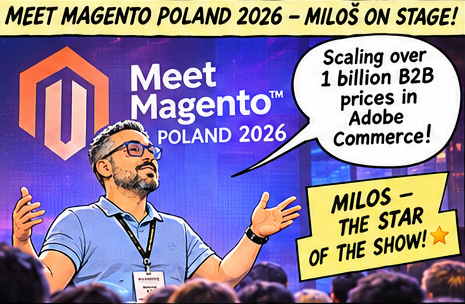
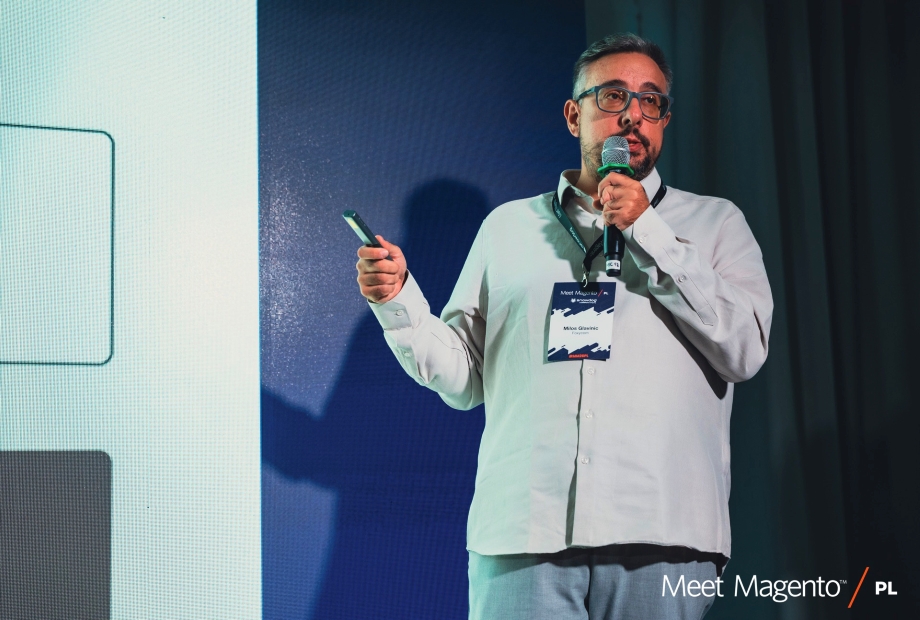
When every customer has negotiated prices, pricing can become one of the hardest scaling problems on a Magento platform. Miloš presented a real Adobe Commerce implementation where SAP ERP held the prices and the combinations grew past one billion.
15,000
products, approximately
6,500
business partners
1 billion+
customer-specific price combinations
Running that dataset through Magento’s standard database and pricing mechanisms wasn’t practical. The architecture went through two stages:
On-premises: a dedicated Redis pricing layer
We moved pricing data outside Magento. Magento retrieved the relevant prices at runtime, Redis kept lookups fast and SAP remained the source of truth.
Adobe Commerce Cloud: a dedicated pricing API service
The original approach couldn’t simply be reproduced within the constraints of the cloud environment. We separated pricing further, so Commerce could consume customer-specific prices without owning the complete dataset.
The session also covered how pricing data was synchronised from SAP, how Magento resolved prices for logged-in B2B customers, the trade-offs along the way and what we would do differently today. The conversations about it carried on well after the talk, which made the trip even more rewarding.
What else stood out in the program
Where Magento stands, and what it should be
Andreas von Studnitz of Hyvä opened with “Magento in 2026: An Honest Update”, tracing how the platform went from a real cause for worry around 2020 to competitive again, with the Magento Association, Adobe, Mage-OS, Hyvä and the community each taking on part of the problem.
Łukasz Gawroński of Spyrosoft took a sharper line in “Magento is the new COBOL of eCommerce”: keep Magento as a stable transactional engine and let pricing, promotions, integrations and workflows move to small services built by AI agents. Pricing on his list caught our attention. We moved pricing out of Magento too, though our reason was data volume, not delivery speed.
AI, with the verification work included
Mateusz Zbylut’s “Slow Down to Speed Up” described how Medistore prepared a headless Magento team for AI-generated change: PHPStan at level 10, a CI pipeline cut in half, wider test coverage and Playwright E2E regression across every storefront. His argument is that an agent is only as good as its feedback loop. As a team with QA built into delivery, we found that a familiar one.
Piotr Siejczuk of Accenture brought numbers from a live B2B/B2C Adobe Commerce instance, using Claude AI, New Relic APM and SPX Profiler in a “measure, hypothesize, fix, verify” cycle. The reported results included 27.5% lower render time and 71% less SQL on a custom split shipment feature. Arseny Kravchenko (Archestra / Amasty) covered how to engineer specialized agents for support in the Magento ecosystem, and Andreas von Studnitz closed the day with “Better Magento Code, Written with AI”.
Security as an operational problem
Sander Mangel’s case study started as a months-long hunt for a performance bug and turned out to be a paid DDoS. The attacker used layered navigation, which generates unlimited unique filter URLs that Fastly doesn’t cache, so every request hit PHP. No exploit was needed. The defense shifted from blocking by source to blocking by request shape, with LLM log analysis used to fingerprint the traffic.
Open source needs maintainers
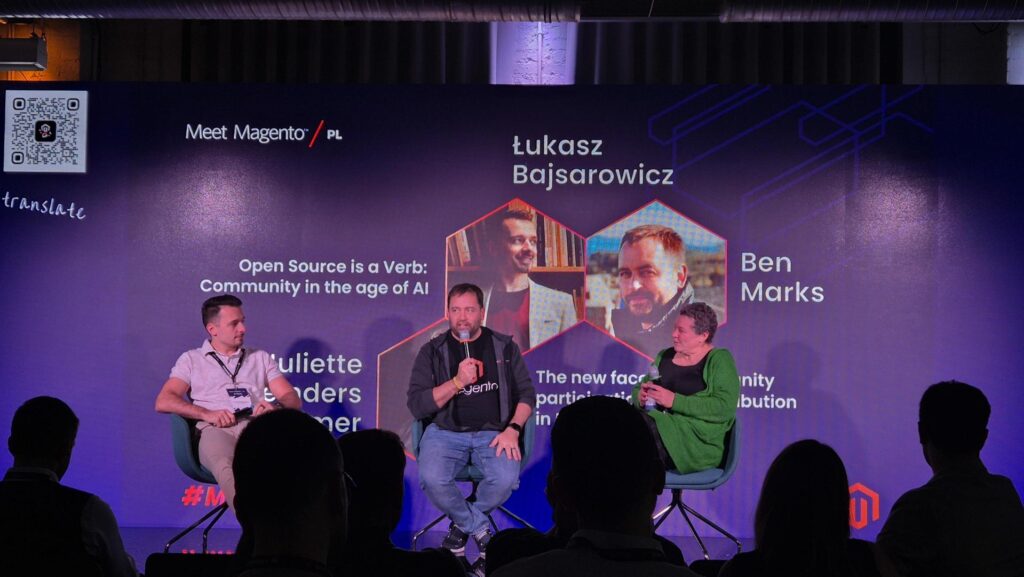
Juliette Reinders Folmer’s “Resurrecting the Dead” asked what happens when a package you depend on is abandoned, and what an organization can do to protect itself. She then joined Ben Marks and Łukasz Bajsarowicz for the “Open Source is a Verb” panel on community contribution in the age of AI.
One of our biggest takeaways was the tension between embracing AI and preserving the human expertise, mentorship, and knowledge-sharing that keep open-source communities alive. Our impression was that much of the audience sympathized with Juliette’s perspective, even as most of us are already adopting the AI-driven approach Łukasz advocated. It’s an interesting contradiction, and perhaps a conversation that needs to happen at a much higher level across the industry.
Perhaps the real challenge isn’t choosing between AI and human expertise, but finding a sustainable balance, one that allows us to benefit from technological progress without compromising the people, communities, and planet that make it possible.
Nino Aratari added a practical Mage-OS example: a digital signature extension supporting DocuSign, Adobe Sign and a lightweight in-house option, including the choice between signing at checkout or after purchase.
Accessibility at checkout
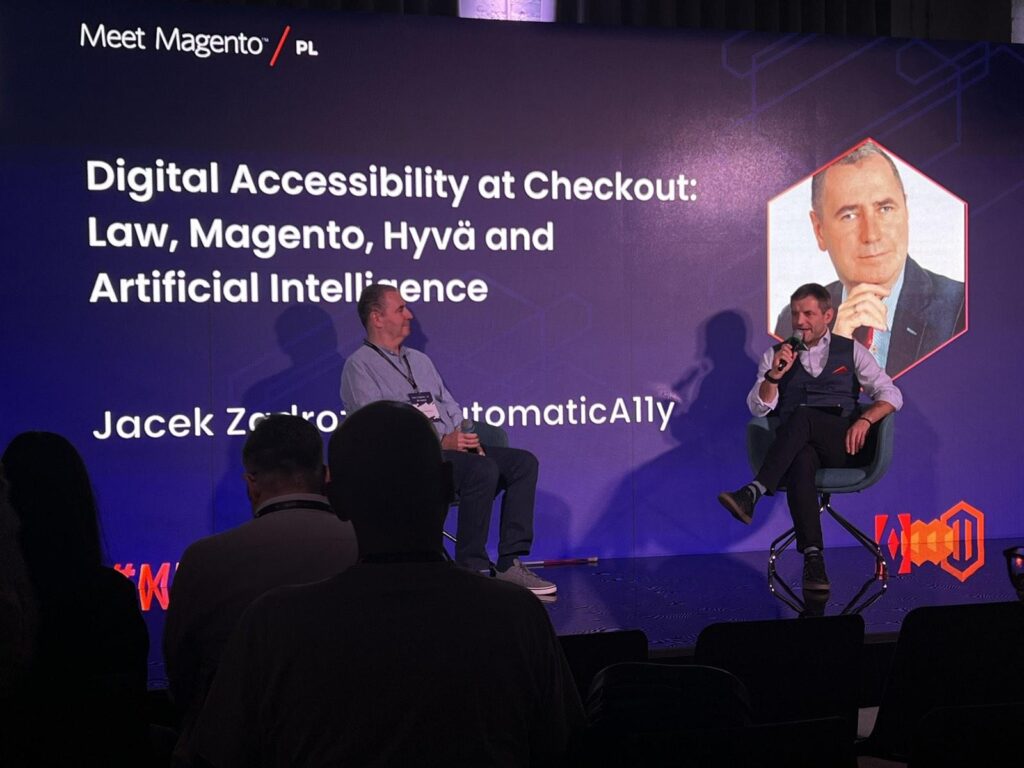
Kuba Zwoliński’s fireside chat with Jacek Zadrożny focused on the part of the store where accessibility has the most direct commercial consequence. Jacek has worked in digital accessibility for over two decades, co-authored Polish legislation and implemented the Digital Accessibility Act at the Ministry of Digital Affairs. He is also blind and uses screen readers every day, which gives him a view of checkout that a specification can’t. He has recently worked on accessibility for stores built on Magento and Hyvä.
The legal background is the European Accessibility Act, which has applied since June 28, 2025 and also covers Polish online stores. Requirements extend to accompanying services such as payment and security functions. Microenterprises are exempt only if they have fewer than ten employees and no more than €2 million in annual turnover or balance sheet total, so most merchants on a platform like Adobe Commerce should assume it applies to them. In practice, teams usually work from the harmonised standard EN 301 549, which references WCAG.
The conversation started from a recent audit of a large Magento store conducted by Hyvä, and looked at what an accessible checkout involves behind the scenes. AI came up from two sides. Accessibility overlays present themselves as the solution to the problem and were treated as a threat, while AI also offers real support for developers and users. The session was aimed at developers, analysts, product owners and store owners alike, on the premise that accessibility is a real technical and legal requirement, not a checklist.
This is close to our own QA work. On Adobe Commerce, we pair automated checks from axe DevTools and Lighthouse with manual testing using a keyboard, NVDA and VoiceOver, because scanners can’t tell you whether someone can actually finish an order. For a checkout, we would start with these:
- Keyboard only: can a customer go from cart to order confirmation without a mouse, with a visible focus state and a logical focus order at every step?
- Step changes: when shipping methods load or the page moves to payment, does the screen reader announce it and does focus land somewhere sensible?
- Form errors: are errors announced, tied to the right field and clear about how to fix them?
- Third-party widgets: do payment iframes, address lookups and CAPTCHAs work with a keyboard and screen reader? Your own code can pass while these block the order.
- B2B controls: do company switchers, requisition lists and custom pricing or quote steps get the same testing? Custom features like these often sit outside a standard theme audit.
Five questions to ask about your own platform
These are the questions we would take from the day to any business-critical Adobe Commerce store.
Does Magento need to own your whole pricing dataset?
Once negotiated prices multiply, moving them outside the platform may be the more stable option.
What can reach PHP without hitting the cache?
Unlimited filter URLs are a performance issue on a normal day and an attack surface on a bad one.
Can you verify changes as fast as you produce them?
Static analysis, CI and regression coverage set the safe pace for AI-assisted work.
Who maintains your critical dependencies?
A healthy package today can be abandoned tomorrow, so it pays to know which ones you can’t lose.
Has anyone tested your checkout with a screen reader?
In the EU, accessibility is a legal requirement for most online stores, and an overlay won’t solve it.
Thank you to Kuba Zwoliński and the Meet Magento Poland team for the organization and the warm welcome in Poznań, and to everyone who came to talk to us about B2B pricing afterwards.
Until next time!