
You don't need to leave Magento. You need to stop treating it like a ticket queue.
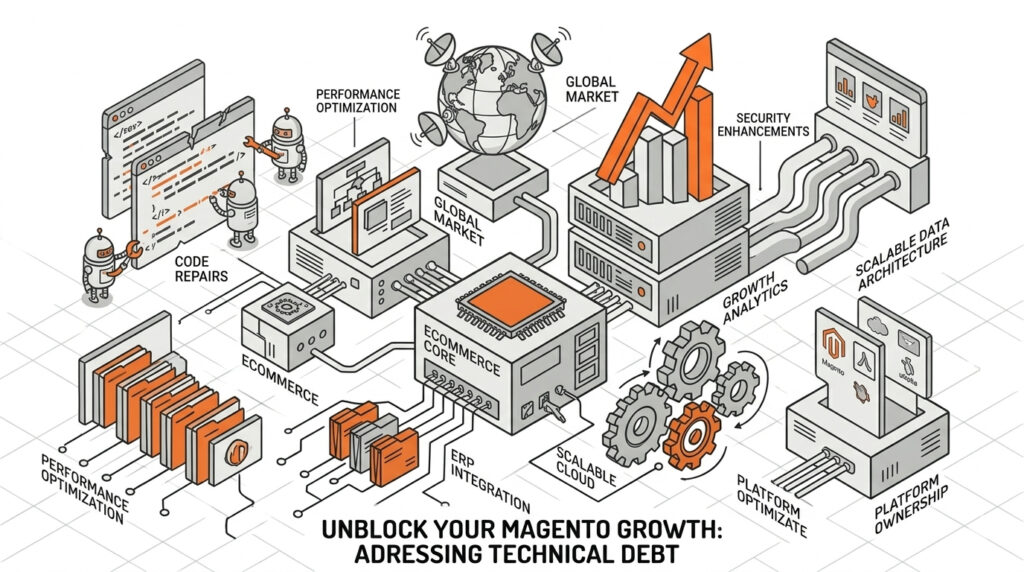
Most Magento merchants who are thinking about replatforming are not suffering from a platform problem. They are suffering from an ownership problem. The platform is fine. What is missing is a senior engineer who holds it accountable — who monitors it proactively, who understands what happens at 2am during a peak, and who takes personal responsibility for what goes out the door.
This article explains the difference between the ticket-driven agency model that most Magento brands rely on, and the architecture ownership model that actually resolves the underlying instability – without the cost, disruption, and risk of migrating to a new platform.
If your Magento store feels fragile, slow to release, or increasingly expensive to maintain – the answer is almost certainly not a new platform. It is a new model of ownership.
Why Magento brands think they have a platform problem
The symptoms are familiar. Releases that take weeks longer than they should. A Black Friday campaign approached with anxiety rather than confidence. An agency invoice that grows every month while the list of unresolved issues grows alongside it. Core Web Vitals that slip quietly while the team firefights something more urgent.
These symptoms feel like a Magento problem. They are not. They are symptoms of a support model that was never designed to take ownership of outcomes — only to respond to tickets.
The agency model works by scope: you define a task, they complete it, you pay for the time. There is no structural incentive for an agency to prevent the next incident, because the next incident is also billable. There is no mechanism for a junior developer — which is who handles most tickets at most agencies — to understand the broader architecture well enough to protect it.
The agency model is optimised for output. What a scaling Magento brand actually needs is ownership — someone who holds the platform accountable between projects, not just during them.
What a Magento migration actually costs
When the instability becomes too painful, the conversation often turns to replatforming. Shopify Plus, commerce tools, headless build. The pitch is always the same: start fresh, leave the technical debt behind, and get a modern stack.
What the pitch rarely includes is an honest account of what migration costs — in time, money, risk, and opportunity.
Direct costs
- Platform migration projects for mid-market brands typically run $200,000–$500,000 in development costs alone.
- ERP, PIM, and third-party integrations must be rebuilt — often the most complex and underestimated part
- Data migration, QA, and UAT add significant time and cost on top of the build
- Most migrations take 9–18 months from scoping to go-live for brands with meaningful complexity
Indirect costs
- Feature development stops during migration — the business runs on the old platform while the new one is built
- Team bandwidth is consumed by the migration project, pulling focus from revenue-generating work
- The new platform carries its own learning curve, its own failure modes, and its own eventual technical debt
- The problems that caused the original instability — lack of ownership, unclear accountability, junior resource — often follow the brand to the new platform
The ticket-driven model vs architecture ownership: what actually changes
The distinction between the two models is not about technology. It is about accountability structures — who is responsible for what, and what happens when something goes wrong.
Ticket-driven agency | Architecture ownership |
Reactive — waits for you to raise issues | Proactive — monitors, flags, and prevents |
Junior developers handle most tickets | Senior-only engineers on every engagement |
Billed per hour or sprint; no outcome SLA | Retainer model with performance accountability |
Platform knowledge resets each project | Accumulates deep platform knowledge over time |
No on-call cover during peak incidents | On-call posture built into the engagement |
Migration pitched when complexity grows | Magento optimised and stabilised — not replaced |
Accountability ends at ticket closure | Ownership extends to business outcomes |
What architecture ownership looks like in practice
Architecture ownership is not a different set of tasks. It is a different relationship with the platform — and a fundamentally different accountability structure.
Senior engineers embedded in an architecture ownership engagement take responsibility for the platform, not just for individual tickets. They understand the integration architecture, the deployment pipeline, the performance baseline, and the behaviour of the system under load. When something breaks at 2am, there is someone who knows the system well enough to diagnose and resolve it — and who is accountable for the outcome.
What changes in the first 90 days
- Core Web Vitals stabilised and monitored with alerting in place
- Integration health checks across ERP, Klaviyo, payment providers, and third-party tools
- Release process reviewed and documented — deployment confidence restored
- Performance baseline established; peak-readiness assessed before the next campaign
- Architecture risk map produced — known vulnerabilities surfaced and prioritised
What ongoing ownership provides
- Continuous optimisation rather than periodic project-based interventions
- Prioritised technical roadmap aligned to business goals
- SLA-backed monitoring with proactive incident prevention
- Direct access to senior engineers — no account managers, no outsourcing
- A technical partner who understands the commercial context, not just the code
Most Magento partners deliver output. Foxycom delivers ownership — senior engineers embedded in your platform, accountable for stability, performance, and scalability.
When replatforming is the right answer
Architecture ownership is not always the answer. There are circumstances where migration is the correct strategic decision:
- The platform has genuine functional gaps that cannot be resolved without rebuilding — for example, a business model that requires capabilities Magento cannot support
- The technical debt has compounded to a point where the cost of stabilisation exceeds the cost of migration — which is rarer than most agencies suggest, but does occur
- The business has a clear, funded, and well-scoped migration plan with senior ownership assigned to both the old and new platform throughout
The critical difference is making that decision with accurate information — not during a moment of platform anxiety following an incident. An architecture audit conducted by a senior engineer who has no commercial interest in migration is the most reliable way to understand whether the platform is worth stabilising or genuinely past its useful life.
Frequently asked questions
What is Magento architecture ownership?
Magento architecture ownership is a model of engagement where senior engineers take ongoing responsibility for the health, performance, and stability of a Magento or Adobe Commerce platform — rather than responding to individual tickets. It includes proactive monitoring, deployment oversight, integration management, and a prioritised technical roadmap aligned to the business.
How is architecture ownership different from a Magento agency?
An agency operates on a ticket or project basis — they complete defined tasks and bill for time. Architecture ownership is accountability-based: the engineers are responsible for the platform outcomes, not just the outputs. This means proactive problem prevention, on-call cover, and a continuous relationship with the platform rather than a series of disconnected projects.
Is Magento still worth using in 2026?
For most mid-market and enterprise brands that are already on Magento, the platform remains a sound investment provided it is properly owned and maintained. The cost and disruption of migration is frequently underestimated. Most brands that experience instability on Magento are suffering from an ownership gap, not a platform limitation.
How much does a Magento migration cost?
A full platform migration for a mid-market ecommerce brand typically costs between $200,000 and $500,000 in direct development costs, with a project timeline of 9 to 18 months. Indirect costs — including halted feature development, team distraction, and ERP re-integration — frequently add significantly to this total.
What are the signs that your Magento platform needs architectural attention?
Common signals include release cycles that have slowed significantly over the past 12 months, recurring incidents rather than isolated ones, Core Web Vitals declining without a clear cause, integration failures that require manual intervention, and a growing sense of anxiety around peak trading periods such as Black Friday.
What does a Magento architecture audit involve?
A Magento architecture audit examines the platform’s structure, performance baseline, integration health, release process, and deployment pipeline. The output is a prioritised risk map that identifies the specific vulnerabilities most likely to cause incidents or limit scalability — and a recommended plan for addressing them.
Is your Magento platform ready for what comes next?
Book a free 20-minute architecture review with a senior Foxycom engineer. No sales pitch – just an honest assessment of where your platform risk lives.