
Magento B2B and B2C:
Why One Store Fails Both Audiences and How to Fix It
Most B2B brands on Magento built their store for one audience. A trade portal for existing accounts. A catalogue for the sales team to reference. A checkout that works — mostly — for buyers who already know what they want.
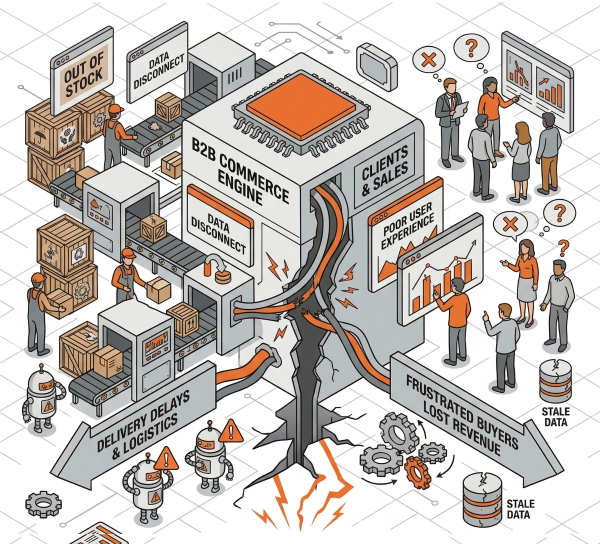
Then the business grew. New channels opened. Direct-to-consumer became a real opportunity, or a strategic necessity. And suddenly the same store that was built for wholesale accounts is being asked to serve retail customers, manage tens of thousands of SKUs, enforce different prices for different buyers, and show the right catalogue to the right person — all at the same time.
Most Magento stores were not built for that. Most of them can be. But not without the right architecture behind them.
The same store that was built for wholesale accounts is now being asked to serve retail customers, manage tens of thousands of SKUs, enforce different prices for different buyers, and show the right catalogue to the right person — all at the same time.
The Hidden Cost of Running Two Audiences Badly
When a B2B brand tries to serve B2C customers through infrastructure that was never designed for it, the problems do not announce themselves dramatically. They accumulate quietly.
A retail customer lands on your store and sees trade pricing. A wholesale account logs in and sees a catalogue that includes products they are not approved to purchase. A new customer segment gets the wrong price tier because the customer group logic was written for three account types and you now have nine. A product goes live on the B2C side before the B2B team has been told it exists.
These are not edge cases. They are the predictable consequence of asking one platform to serve two audiences without giving it the architecture to do so deliberately.
The business cost is real on both sides. B2C customers who see pricing or catalogue inconsistencies do not convert. B2B buyers who hit friction — wrong prices, wrong products, wrong experience — stop self-serving and start calling your account team. The operational overhead compounds. The revenue opportunity on both sides remains unrealised.
Magento can run B2B and B2C from a single instance. Done properly, it is one of the platform’s genuine strengths. But it requires deliberate architecture — not an afterthought bolted onto an existing trade portal.
One Store, Two Audiences: How to Do It Without Breaking Either
The foundation of a well-architected B2B and B2C Magento store is a clear separation of experience at the store view level, combined with shared catalogue and pricing infrastructure underneath.
This means:
Separate store views for B2B and B2C — different URLs, different navigation, different checkout flows, different default pricing — while sharing the same product catalogue, inventory, and order management backend. You maintain one platform, not two. You update a product once, and it propagates correctly to both audiences.
Customer group architecture that reflects how your business actually segments its buyers. Not just “wholesale” and “retail” — but the full picture. Key accounts on negotiated pricing. Trade customers on standard B2B rates. Retail customers on RRP. New accounts on provisional terms until they are approved. Each group sees the right prices, the right catalogue, and the right checkout experience without any manual intervention.
Catalogue visibility rules that are enforced at the platform level, not managed by hand. Certain products should only be visible to approved trade accounts. Others should be available to both audiences but at different price points. Some should be restricted by geography, by account type, or by a combination of both. When this logic lives in the platform architecture rather than in someone’s head or a spreadsheet, it scales. When it does not, it breaks — usually at the worst possible moment.
Price Tiers That Reflect How B2B Actually Works
Pricing is where most dual-audience Magento stores expose their structural weaknesses most clearly.
B2C pricing is relatively simple. A product has a price. It might have a sale price. There might be a promotional rule applied to a category or basket total. The logic is manageable.
B2B pricing is a different problem entirely. A single product might have fifteen different prices across your account base — negotiated rates for key accounts, volume-tiered pricing for mid-market buyers, standard trade pricing for smaller accounts, and a different currency or tax treatment for international customers. These prices change. Contracts are renegotiated. Volume thresholds are adjusted. New tiers are introduced.
When this logic is implemented correctly in Magento — using customer groups, tier pricing, and catalogue price rules in combination — it is maintainable and scalable. When it has been implemented incrementally, by different developers at different times, without a coherent architecture behind it, it becomes one of the most fragile parts of the entire platform.
The signs of fragile pricing architecture are consistent: incorrect totals appearing at checkout for specific account types, promotional rules that conflict with contract pricing, manual price corrections being made by your team after orders have been placed, and a growing reluctance to make pricing changes because nobody is entirely sure what else will break.
What good looks like: A single, documented pricing hierarchy. Clear rules of precedence — which pricing logic takes priority when multiple rules apply to the same customer and product. A testing process that validates pricing for key account types before any change goes live. And a senior engineer who understands the full pricing architecture, not just the last ticket they were asked to complete.
Managing Thousands of SKUs Without Losing Control
A B2B catalogue is rarely small. Manufacturers, distributors, and wholesalers commonly manage tens of thousands of SKUs — with variants, configurable products, custom attributes, and product relationships that make a B2C catalogue look straightforward by comparison.
At scale, catalogue management becomes one of the most operationally expensive parts of running a Magento store. Products need to be updated across multiple store views. Attributes need to be maintained consistently. New product ranges need to be introduced without disrupting existing catalogue structure. And all of this needs to happen quickly enough to keep pace with the business.
Without a PIM — a Product Information Management system — integrated properly with Magento, most brands manage this through a combination of spreadsheet imports, manual admin updates, and tribal knowledge about which fields need to be populated in which order. It works until it does not. And when it breaks, it tends to break visibly — wrong product data on the storefront, missing attributes causing search and filtering to fail, catalogue imports that corrupt existing data rather than updating it cleanly.
A well-integrated PIM changes this fundamentally. Product data is managed in one place, with clear ownership and validation rules, and published to Magento — and any other channel — from a single source of truth. New products are introduced through a defined workflow. Attribute changes are propagated consistently. The catalogue scales without scaling the team that manages it.
The integration between your PIM and Magento is where most of the complexity lives. It needs to handle large data volumes reliably, manage the relationship between configurable products and their variants correctly, and maintain data integrity across both systems when changes are made from either side. Getting this right requires senior engineering judgment — not just a standard connector.
Getting this right requires senior engineering judgment — not just a standard connector.
The Architecture Question Behind All of This
Running B2B and B2C from one Magento store, enforcing catalogue visibility rules, managing complex pricing tiers, and integrating a PIM at scale — these are not simple problems. But they are solved problems. Magento has the capability to handle all of them, and to handle them well.
What they have in common is that they all require deliberate architecture — decisions made at the platform level by engineers who understand both the technical constraints and the commercial requirements behind them. They cannot be solved ticket by ticket, by a junior developer responding to what is in the queue this sprint.
If your store is showing the symptoms described in this article — pricing inconsistencies, catalogue control problems, operational overhead that grows with every new SKU or customer segment — the platform is not the problem. The ownership model is.
Frequently asked questions
Can Magento run B2B and B2C from the same store?
Yes, and when it is architected correctly, it is one of Magento’s strongest capabilities. Using separate store views for each audience, combined with shared catalogue and inventory infrastructure underneath, a single Magento instance can serve wholesale accounts and retail customers simultaneously. The key is that this separation needs to be designed deliberately, not retrofitted onto an existing build.
How does Magento handle different price tiers for different customers?
Magento manages B2B pricing through a combination of customer groups, tier pricing rules, and catalogue price rules. A wholesale account can see negotiated contract pricing, a mid-market buyer can see volume-tiered rates, and a retail customer sees RRP, all from the same product catalogue. The challenge is not whether Magento can do this, but whether the pricing architecture has been implemented with a clear hierarchy and tested properly across all account types.
What is a PIM and does a Magento B2B store need one?
A PIM (Product Information Management system) is a centralised platform for managing product data before it is published to your storefront and other channels. For B2B brands managing thousands of SKUs with complex attributes, variants, and multi-channel requirements, a PIM is not a luxury. It is the difference between a catalogue that scales and one that requires a growing team to maintain it manually. Common PIM platforms that integrate with Magento include Akeneo, Pimcore, and inRiver.
How do you control which products are visible to which customers in Magento?
Catalogue visibility in Magento is managed through a combination of customer groups, category permissions, and shared catalogues — a feature available in Adobe Commerce. When configured correctly, a trade account sees only the products they are approved to purchase, a retail customer sees the public catalogue, and restricted products never appear to unauthorised buyers. This logic needs to be maintained as the business evolves – new account types, new product ranges, and new channels all create opportunities for visibility rules to break if they are not actively managed.
What is the difference between Adobe Commerce and Magento Open Source for B2B?
Adobe Commerce, the paid, enterprise version of Magento, includes a dedicated B2B module that adds native support for company accounts, shared catalogues, requisition lists, purchase order workflows, and quote management. Magento Open Source can handle B2B requirements but typically requires more custom development to achieve the same outcomes. For brands with significant B2B complexity, Adobe Commerce’s native B2B features are often worth the licence cost compared to the development investment required to build equivalent functionality from scratch.
How do you know if your Magento pricing architecture has a problem?
The most reliable indicators are operational rather than technical. If your team is regularly correcting order prices after they have been placed, if promotional rules occasionally override contract pricing for key accounts, if new pricing changes require extensive testing across multiple customer groups before anyone is confident enough to deploy them — these are symptoms of a pricing architecture that has grown beyond its original design. The fix is not a new platform. It is a pricing architecture review conducted by a senior engineer who understands the full hierarchy.
Is replatforming to Shopify Plus or commercetools the answer for a B2B brand?
Rarely and almost never for the reasons that tend to drive the conversation. The instability, pricing complexity, and catalogue management problems that B2B brands experience on Magento are ownership problems, not platform problems. A brand that has outgrown its current architecture on Magento will face the same structural challenges on a new platform if the underlying ownership model does not change. Migration should be considered when Magento has a genuine functional gap the business cannot work around — not as a response to an incident or a period of instability.
Is Your Magento Store Ready to Serve Both Sides of Your Business?
Book a free 20-minute architecture review with a senior Foxycom engineer. We will assess your current store view structure, pricing architecture, catalogue setup, and integration health and give you a clear picture of what needs to change and what does not.
No sales pitch. No obligation. Just an honest view of where the gaps are.