
Why B2B and wholesale on Magento breaks - and what it actually takes to run it properly
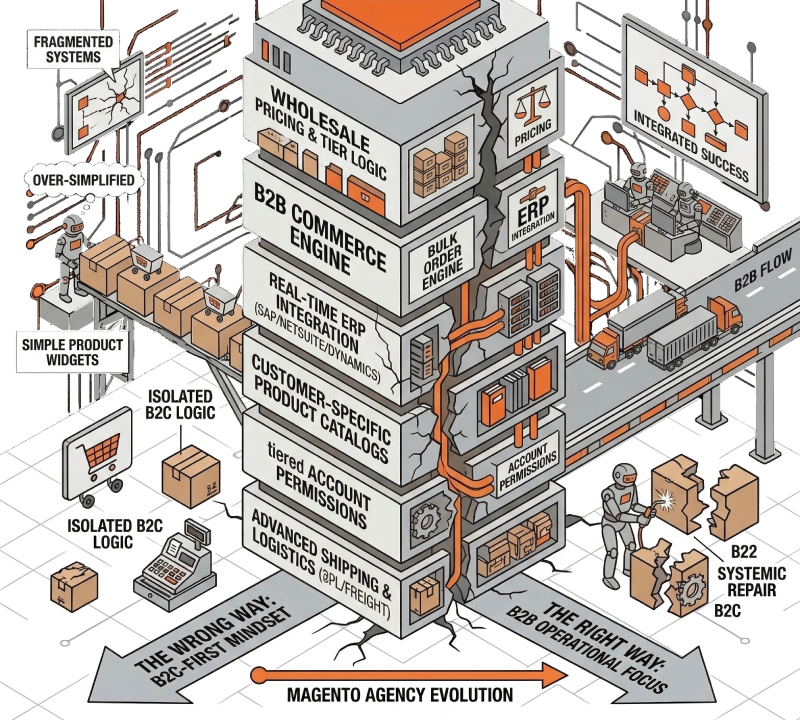
Magento and Adobe Commerce are two of the most capable platforms for B2B and wholesale ecommerce. They handle tiered pricing, account-based catalogues, complex approval workflows, and high-volume order processing in ways that B2C-first platforms simply cannot match natively.
And yet B2B brands on Magento consistently report the same painful experiences: ERP integrations that break without warning, pricing logic that fails after a deploy, account hierarchies that drift out of sync, and a support model that was never built for the complexity they are running.
This article explains why B2B Magento is fundamentally more demanding than B2C Magento, where the most common failure points live, and what it takes to run a B2B or wholesale Magento deployment with genuine stability.
B2B on Magento is not a bigger version of B2C Magento. It is a different operational challenge, one that most agencies are not structured to support properly.
What makes B2B Magento fundamentally different
A B2C Magento deployment is complex. A B2B deployment running at scale is an order of magnitude more so. The technical surface area is larger, the data dependencies are deeper, and the consequences of failure are more severe, a broken ERP sync on a B2B platform can mean delayed fulfilment for dozens of wholesale accounts, not a single consumer order.
The complexity layers specific to B2B
- Account-based pricing: tiered and contract-specific pricing rules that must resolve correctly for every customer and every SKU
- Customer-specific catalogues: product visibility, availability, and pricing that varies by account, not just by product category
- ERP dependency: most B2B Magento platforms sync order data, inventory, and pricing with an ERP system, often in near-real-time
- Approval workflows: purchase order approval chains, credit limit enforcement, and quote-to-order conversion logic
- Account hierarchy management: parent and child account structures with inherited permissions and inherited pricing
- High order volumes: B2B brands often process far higher order volumes than their GMV suggests, particularly wholesale repeat orders
- Complex payment terms: net payment terms, trade credit, and invoice-based billing that require careful integration with finance systems
Each of these layers works fine in isolation. The failure risk comes from their interaction, and from deploying changes without understanding how they affect each other.
Where B2B Magento deployments break in practice
The failure modes in B2B Magento are specific, recognisable, and rarely random. They cluster around the same pressure points, and they tend to surface at the worst possible times.
ERP synchronisation failures
The ERP integration is typically the most critical and the most brittle component of a B2B Magento deployment. Pricing data, inventory levels, and order status all depend on a reliable sync, and the sync is usually the first thing to fail under load, after a deploy, or when either system undergoes a version change. The typical failure pattern: the sync runs silently, a timeout occurs somewhere in the chain, orders stop processing or pricing updates stop flowing, and the first sign of the problem is an angry wholesale account calling to ask why their last order has not shipped.- Pricing logic breaking on deploy
Tiered pricing and account-specific pricing rules in Magento involve multiple interacting systems: catalog price rules, customer group pricing, shared catalogues, and often a custom pricing engine built on top. A deploy that touches any part of the commerce layer can break the pricing resolution without a visible error, prices simply resolve to the wrong tier, or fail to resolve at all. In a B2B context where customers expect contract pricing, this is not a UX issue. It is a commercial one. - Account and permission drift
As a B2B account base grows, account hierarchy data drifts. Child accounts lose inheritance from parent accounts. Permission sets become inconsistent. Credit limits stop syncing correctly with the ERP. These issues are invisible until a customer cannot access their catalogue or places an order against a credit limit that has already been exceeded, at which point the fix is reactive, not proactive. - Integration queue overload under peak load
B2B brands often have concentrated peak periods, a major wholesale campaign, an end-of-quarter ordering surge, a product launch to trade accounts. During these periods, the message queues that power ERP sync, inventory updates, and order processing can back up significantly. Without queue monitoring and load testing, the first indication of a problem is a queue that has fallen hours behind real time, meaning order data arriving in the ERP significantly after the orders were placed. - Deployment risk from interdependent systems
A standard Magento deployment pipeline needs to test commerce functionality. A B2B deployment pipeline needs to test account-based pricing resolution, ERP sync health, approval workflow integrity, and catalogue access by account type, all of which can break independently of the primary deploy. Without B2B-aware QA gates, deployments carry a significantly higher risk of releasing a configuration that works in B2C but fails in B2B contexts.
Why standard agency support fails B2B deployments
The ticket-driven agency model was designed around B2C ecommerce: well-defined features, bounded scope, a relatively shallow integration surface. B2B Magento deployments break that model in several ways.
- The failure modes are systemic, not symptomatic, a pricing bug is usually a data model issue, not a code error. A junior developer resolving a ticket cannot see that.
- The integration context is essential, you cannot debug an ERP sync issue without understanding both the Magento data model and the ERP schema. Most agencies understand one, not both.
- The failure consequences are commercial, a broken B2B platform is not just a UX problem. It affects order fulfilment, customer relationships, and commercial credibility. That requires ownership, not a ticket.
- B2B QA requires B2B context, testing that an order completes is not sufficient. Testing that an order completes at the correct contracted price for a specific account, against the correct credit limit, with the correct approval routing, requires someone who understands the configuration in full.
B2B Magento needs an engineer who understands the whole system not just the ticket in front of them. That requires embedded ownership, not reactive support.
What stable B2B Magento ownership looks like
Stable B2B Magento ownership is not a different set of tools. It is a different accountability structure, senior engineers who hold the platform responsible for its behaviour across all the layers that matter to a B2B business.
Integration monitoring
ERP sync health should be monitored in real time, with alerting on queue depth, sync latency, and error rates. A sync that is running 20 minutes behind on a standard day needs to be caught before it becomes a 4-hour backlog on a peak day.
Deployment gates for B2B-critical systems
Every deploy should pass automated checks on pricing resolution by account type, catalogue access by customer group, and ERP connectivity, before it reaches production. These gates do not exist in a standard Magento deployment pipeline without someone who has specifically built them.
Account data integrity checks
Account hierarchies, credit limits, and permission sets should be reconciled against the ERP on a regular schedule, not on demand after a customer complaint. Drift is inevitable; the question is whether it is caught proactively or reactively.
Peak preparation
Before a significant wholesale campaign or end-of-period surge, the platform should be assessed for queue throughput, ERP sync capacity, and integration failure handling. A load test that replicates realistic B2B order patterns, bulk ordering, repeat orders, account-specific pricing under volume, is meaningfully different from a B2C traffic simulation.
Frequently asked questions
What is Magento B2B and how does it differ from B2C?
Magento B2B (and its enterprise-tier equivalent, Adobe Commerce B2B) is a set of modules built on top of the core Magento platform that enable account-based ordering, tiered and contract pricing, purchase approval workflows, and shared catalogue management. It is designed for wholesale and trade commerce, where customers are businesses rather than individual consumers. The key difference from B2C is the depth of account-specific configuration and the critical dependency on ERP integration.
What is the most common cause of failure in B2B Magento deployments?
ERP synchronisation is consistently the highest-risk integration point in B2B Magento deployments. Order data, pricing, inventory, and credit limits all depend on a reliable sync and the sync is vulnerable to deploy changes, version mismatches, and load spikes in ways that are not always visible until commercial damage has occurred.
How should Magento B2B ERP integration be monitored?
Effective ERP integration monitoring in Magento should track queue depth, sync latency, error rates, and message processing throughput in real time. Alerting should be configured to surface queue backlogs before they reach a threshold that affects order data reliability. Integration health should also be part of the pre-deploy checklist, a deploy that breaks ERP connectivity is one of the highest-cost failures in a B2B environment.
Can Magento handle complex B2B pricing with tiered and contract rates?
Yes, Magento and Adobe Commerce B2B support tiered pricing, customer group pricing, shared catalogues with account-specific pricing, and custom pricing rules. The complexity is not in the capability, but in the operational maintenance of those pricing layers over time, and in the deployment testing required to ensure that pricing resolution remains correct after changes to any part of the commerce configuration.
How do you test B2B Magento before a major deploy?
A B2B-aware QA process should test pricing resolution by account type and customer group, catalogue access and visibility by account, approval workflow routing, ERP connectivity and sync health, and order processing under realistic B2B order patterns. This is significantly more involved than B2C QA, and it requires test data that reflects the actual account configuration not just synthetic test users.
What are the signs that a B2B Magento deployment needs architectural attention?
Key signals include: ERP sync errors appearing more than occasionally, pricing complaints from wholesale accounts, order processing delays during peak periods, catalogue or permission issues reported by customers, and a deployment process that requires manual verification rather than automated gates. If your team is spending meaningful time each week on B2B-specific operational issues, the platform is not being properly owned.
Is your Magento platform ready for what comes next?
Book a free 20-minute architecture review with a senior Foxycom engineer. No sales pitch – just an honest assessment of where your platform risk lives.